Guide
Wolf Oven Self-Cleaning Problems: Causes and Fixes
Why a Wolf oven's self-clean cycle won't start, locks the door or leaves the oven dead, how to run it safely, and what typical repairs cost.
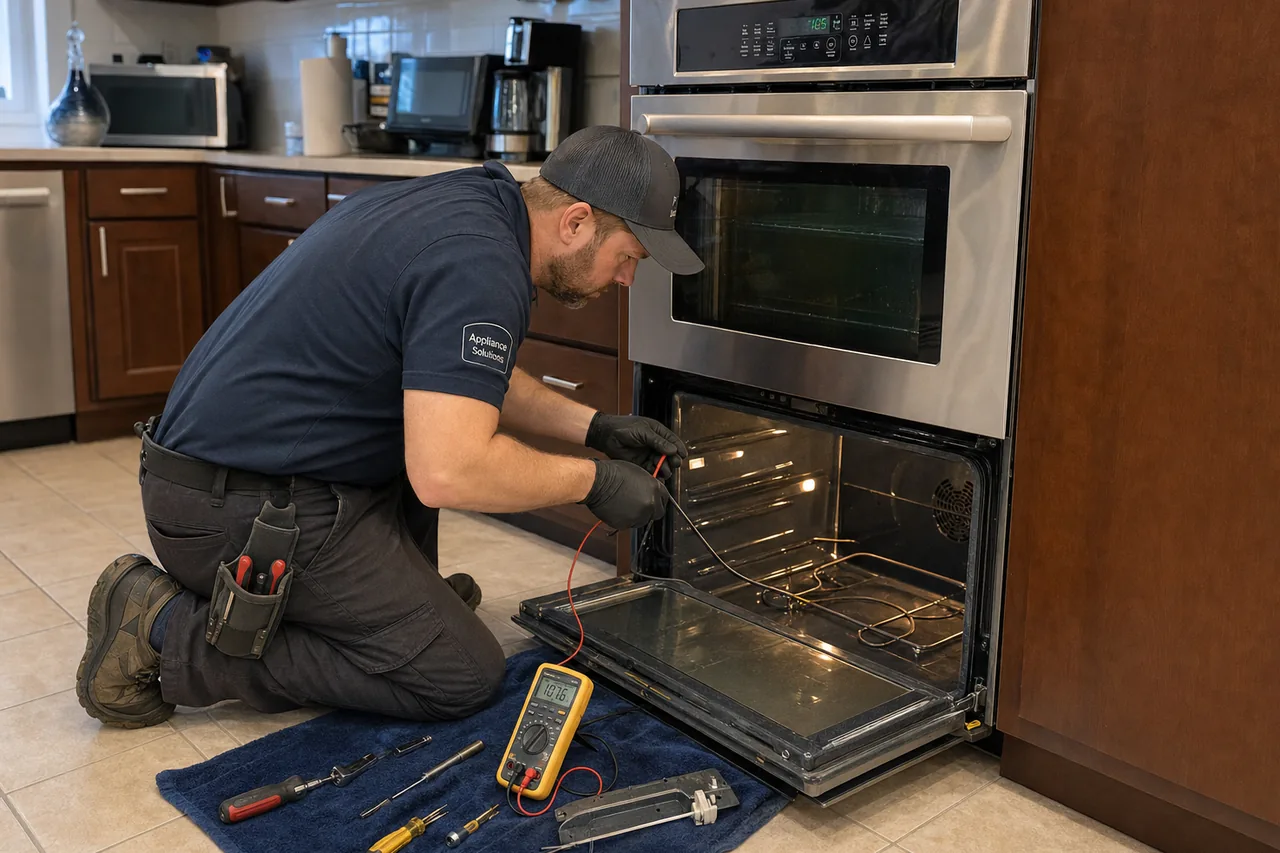
Wolf oven self-cleaning problems usually come down to three things: the door won’t lock, the door stays locked after the cycle, or the oven stops heating because the 800–900°F cycle overheated a fuse, sensor, element or control board. A locked door often clears on its own within 30 to 90 minutes of cool-down, but a cycle that keeps faulting usually needs a part, with typical repair ranges of $250–$900 after a $95–$149 diagnostic.
How does self-clean work on a Wolf oven?
Self-clean on Wolf wall ovens and on the electric oven of a Wolf dual fuel range is pyrolytic. The oven heats far past any cooking temperature, roughly 800 to 900°F, and turns baked-on grease into a fine gray ash. Because the cavity gets that hot, a motorized latch locks the door before the heat climbs and keeps it locked until the oven cools. Heat-up, cleaning and cool-down together typically take 3 to 5 hours.
Not every Wolf cooking appliance has this cycle. Steam ovens clean differently, and many all-gas range ovens have no pyrolytic setting. If you can’t find a self-clean option, check the use-and-care guide before assuming something is broken.
How do you run a Wolf self-clean cycle safely?
Most failures start with a cycle run on a dirty, cluttered oven. Follow these 7 steps:
- Let the oven cool, then remove the racks, temperature probe, pans and any foil. Leave racks in only if your use-and-care guide allows it.
- Scrape up large spills and pooled grease. Heavy deposits smoke hard and can flare at self-clean temperatures.
- Wipe the door frame outside the gasket with a damp cloth. Do not scrub or pull the gasket itself; it tears easily.
- Turn on the range hood, crack a window and move pet birds out of the house, since their lungs are sensitive to the fumes.
- Close the door firmly, select self-clean and confirm the lock indicator comes on.
- Stay home for the whole cycle, and never force the door while it is locked.
- Once the door unlocks and the oven is cool, wipe out the ash and put the racks back.
One practical rule: don’t run self-clean a day or two before a holiday meal. If a part fails, you lose the oven exactly when you need it.
Why won’t the self-clean cycle start or the door lock?
Before heating, the control checks that the door is locked. If it doesn’t get that signal, it cancels the cycle or flashes the lock light. Common reasons:
- A rack, pan handle or crumb build-up at the hinge keeps the door from closing fully.
- The latch motor runs but the lock switch never reports “locked,” so the control refuses to heat.
- The latch motor has failed and you hear nothing when the cycle starts.
- The control board has a fault. Write down any code or message on the display.
Close the door firmly and restart. If that fails, turn the oven’s breaker off for one to two minutes, then back on, and try once more. If the cycle still cancels, the latch assembly or control needs a technician.
Why is the door still locked after self-clean?
A locked door right after the cycle is normal. The latch stays closed until the cavity drops to a safe temperature, commonly 30 to 90 minutes after the cycle ends.
If the oven is cool hours later and the door is still locked, the latch motor may be stuck, the lock switch may have failed, or a power blip may have confused the control. Switch the breaker off for a minute or two and restore power; the latch often cycles open. Do not pry the door. That bends the latch, strains the hinges and can crack the inner glass, turning a simple repair into a larger one.
Why did the oven stop heating after self-clean?
This is the most common call after a self-clean, because the cycle is the hardest workout the oven ever gets. A thermal fuse can trip to protect the oven, a temperature sensor can drift, a bake element can burn open, and electronics near the control panel can be stressed by the heat. Check that the breaker hasn’t tripped, then use the table below.
| Symptom after self-clean | Likely cause | First check | Typical repair range |
|---|---|---|---|
| Door won’t lock, cycle cancels | Latch motor or lock switch | Close door firmly, reset breaker | $250–$900 |
| Door locked hours later, oven cold | Stuck latch or control fault | Breaker off for 1–2 minutes | $250–$900 |
| Oven dead or display blank | Thermal fuse or control board | Confirm breaker, then call | $400–$850 |
| Heats, but runs hot or cold | Temperature sensor | Oven thermometer at 350°F | $280–$450 |
| Element glowed, then quit | Bake element burned open | Look for a blister or break | $250–$500 |
| Heat or smoke at the door edge | Door gasket | Look for flattening or tears | $150–$450 |
These are typical ranges, not quotes; the firm quote is given on site after diagnosis. See repair pricing for more.
What should you do after a self-clean cycle?
Wipe the ash with a damp cloth, then test the oven before you rely on it. Bake at 350°F with an oven thermometer in the center and read it after 20 minutes; a reading far off the setting points to the sensor. Check the gasket for gaps or frayed spots. Faint white streaks are usually mineral residue and wipe off with vinegar and water. Don’t run a second cycle back-to-back to chase one stubborn spot.
How do you clean a Wolf oven that is not self-cleaning?
Clean it by hand. Spread a paste of baking soda and water on the cool oven floor and walls, leave it overnight, then wipe it off with a damp cloth. Mist any white film with vinegar and water and wipe again. Use soft pads only, keep cleaners off the gasket and probe jack, and skip harsh oven cleaners unless your use-and-care guide approves them. Wiping spills while the oven is warm, not hot, keeps deep cleaning rare.
When should you call for oven repair in Irvington?
Call when the door stays locked on a cold oven after a breaker reset, the cycle cancels repeatedly, the oven won’t heat after cleaning, or you see scorching near the control panel. Irvington has many older homes, and in a closed-up house in winter, self-clean smoke travels quickly, so a failing cycle is worth fixing rather than repeating.
Irvington Wolf Appliance Repair is an independent service, not manufacturer-authorized, handling wall oven repair and Wolf dual fuel ranges in Irvington, Tarrytown, Dobbs Ferry and Hastings-on-Hudson. Call (914) 275-0968 to book a diagnosis.
Frequently asked questions
How long does a Wolf oven self-clean cycle take?
A full cycle with cool-down typically takes 3 to 5 hours. The door stays locked until the oven has cooled.
Can I open the oven door during self-clean?
No, the door locks on purpose while the oven is at 800 to 900°F. Wait for the lock to release on its own.
Why does my oven smell after self-cleaning?
A light odor is normal as residue burns off. Heavy smoke usually means large spills were left inside, so scrape them out before the next cycle.
Is it bad to self-clean a Wolf oven often?
Frequent cycles add heat stress to the latch, sensor, fuse and electronics. Clean small spills by hand and save the cycle for heavy buildup.